The Brandenburg Gate opened on 6 August 1791 as the Friedenstor, yet its fame now rests on a century it was never meant to represent. That mismatch is the point. A royal city gate built for controlled movement became the place Berlin uses when it wants to show the world it can open itself again.
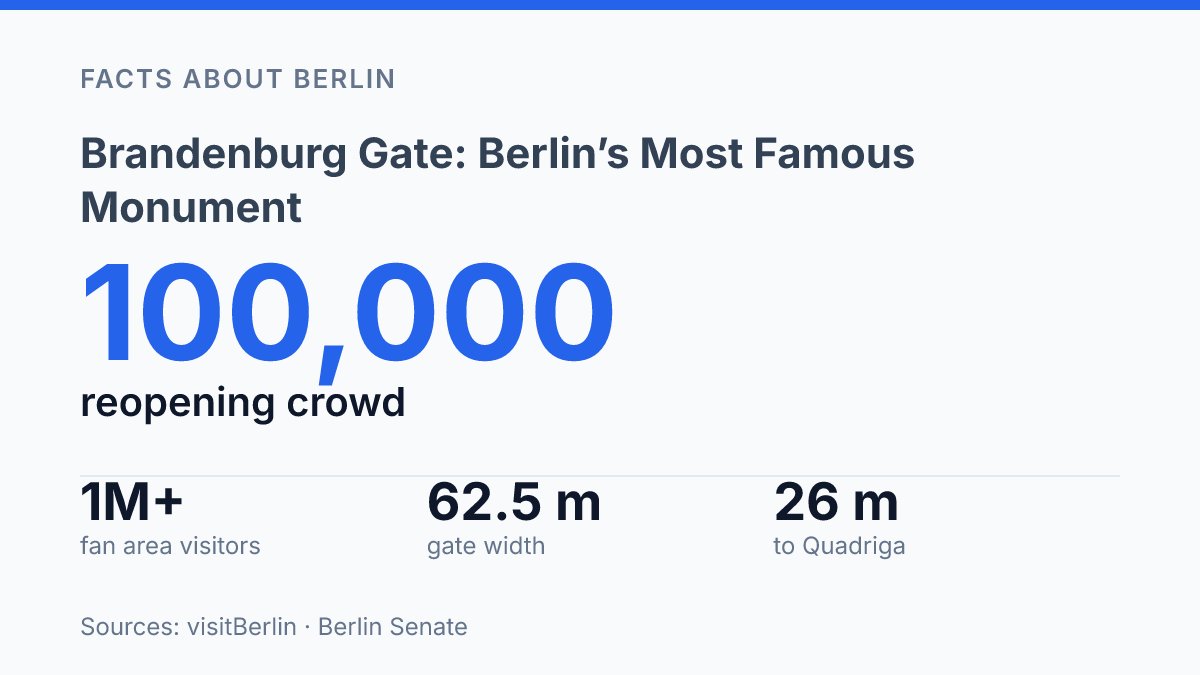
The details are sharper than the postcard suggests. The main structure reaches 20.30 metres, the Quadriga lifts it to about 26 metres. The central passage is wider than the four beside it.
Design was never neutral here. Neither was access.
This article looks at how the Brandenburg Gate rose, why its proportions matter, how it turned from a sealed Cold War border into a public symbol, and why crowds still gather there. In 1989, 100,000 people came for its reopening. In my honest opinion, that’s when architecture became evidence.
How the monument rose in 1791
The Brandenburg Gate began as a replacement, not a relic: Berlin tore out an older controlled entry and turned the same threshold into a royal showpiece. Construction began under King Frederick William II of Prussia.
The new structure was completed in 1791. The Landesdenkmalamt Berlin records the replacement gate as dating to 1788–1791 and says it opened as the Friedenstor on 6 August of that final year.
The commission went to Carl Gotthard Langhans, who gave Berlin a neoclassical entrance rather than a medieval-looking barrier. That choice mattered. The king wanted an approach that spoke in the language of order, ceremony, and power, not just defense.
Its placement was the sharper point. The monument stood where a former city gate had marked the start of the road west toward Brandenburg an der Havel, the older political center tied to the region’s name.
If you entered Berlin there, you didn’t just pass through stone. You crossed a line the city already understood.
That creates the tension at the heart of its origin. It was built as a triumphal entrance. It also sat on a former boundary line.
Arrival and control met in the same opening. That dual purpose gives the monument more bite than a simple royal façade.
Langhans made that message physical with 12 Doric columns, arranged to create five passageways. The form welcomed movement. It also organized it. In my view, that’s the detail that makes the gate’s early history so revealing: Berlin didn’t remove a boundary so much as dress it in classical authority.
Why the design stands out
The whole structure reaches about 26 metres only because its roof carries a copper chariot. That chariot is the Quadriga, a four-horse statue driven by the goddess of victory.
Landesdenkmalamt Berlin dates its copper execution to 1790–1793. It belongs to the original visual idea rather than a later decorative afterthought.
At street level, the design is controlled almost to the point of severity. Its neoclassical language shows in the Doric order, the clean horizontal lines.
The calm balance of the façade. You don’t need an architecture glossary to see the effect: the gate looks measured, heavy, and disciplined.
Then the roof breaks the mood. The Quadriga turns that restraint into theatre, with movement, horses, wheels. A raised emblem of victory above an otherwise sober stone frame. In my honest opinion, that contrast is the reason the monument stays in your memory after larger buildings start to blur together.
The front view also works because the rhythm is easy to read. Six main columns form five passageways, so your eye counts the openings almost before you notice the details. According to visitBerlin, the central passage is 5.65 metres wide, compared with 3.80 metres for the side openings, which explains why the middle feels more ceremonial.
That wider central route once carried social meaning too. It was reserved for royalty, while others used the narrower passages.
The design looks symmetrical from a distance. The hierarchy is built into the way people moved through it.
From closed border to open symbol
A monument built for passage spent nearly three decades as a place most Berliners couldn’t cross. That reversal gives the gate its sharpest 20th-century meaning: a civic entrance became a marker of enforced separation.
When the Berlin Wall went up near the gate in 1961, the area around it changed from public space into a controlled border zone. The monument stood close to the line between East and West Berlin.
It didn’t belong fully to either side in the daily life of the city. It was visible, photographed, and politically loaded… yet physically out of reach for ordinary movement.
That matters more than any abstract reading of “freedom.” During the Cold War, the gate’s meaning came from Berlin’s split geography. Leaders could gesture toward it.
Crowds could gather near it. But the structure itself sat inside a system built to stop exactly the kind of crossing it was designed to frame.
The contradiction is the point. A monument made to welcome traffic later stood beside a sealed frontier.
That clash is why its image still carries force. In my humble opinion, the gate doesn’t move people because it is simply beautiful. It moves them because Berlin made its beauty politically uncomfortable.
In 1989, the fall of the Wall changed the way people read the site almost overnight. The same place that had symbolized blocked movement became a stage for reunion. According to visitBerlin, about 100,000 people gathered for the gate’s official reopening on 22 December 1989, a crowd large enough to turn architecture into public evidence that the city had changed.
The monument didn’t shed its history after that moment. It absorbed it. Today, its meaning rests on the fact that Berliners remember both versions at once: the closed border and the reopened passage, the hard line and the breach in it.
Why people still go there
No ticket office stands in front of it. It still pulls crowds like a paid attraction. The proof is plain: millions of visitors stop there each year to photograph it, walk through it, or simply stand under the columns for a minute.
That matters. A landmark that charges nothing has to earn attention in public, without timed entry or museum drama.
The square helps. Pariser Platz gives the monument space to be seen straight on, so people don’t experience it as a detail on a street corner. They arrive, pause, take the same photo as everyone else… and somehow the ritual still works.
Its pull also comes from age. Official monument records date the replacement gate to 1788–1791 and say it opened as the “Friedenstor” on 6 August 1791, according to Landesdenkmalamt Berlin, accessed. That long timeline gives every modern visit a strange double layer: you’re looking at a familiar media image, but also at stone and sculpture that outlived political systems.
In my view, what’s striking is that the gate is both overexposed and still powerful. That’s rare for a landmark this famous.
It appears so often that it should feel tired. Instead, the repetition has made it shorthand for the city itself.
That’s why it remains Berlin’s official image in practice, even when no one formally says so. It turns up on postcards, international news coverage, tourism campaigns, state visits, protest backdrops, New Year broadcasts, and large public events. During Euro 2024, the official fan areas at the gate and the Reichstag drew more than 1 million people, which shows how easily the site shifts from photo stop to civic stage.
Cameras are part of the point, not a distraction from it. People go there because they’ve seen the image before. They stay because the real place is bigger, colder, louder, and more exposed than the postcard suggests.
The next crowd will change the meaning again
The next crowd will change the meaning again
The Brandenburg Gate doesn’t need a ticket count to prove its pull. VisitBerlin leaves open public places out of its attraction rankings because the numbers aren’t collected there, but Berlin’s Euro 2024 fan areas around the gate and Reichstag drew more than 1 million people.
That’s the useful contradiction. The place is too public to measure cleanly.
Go there early if you want the stone. Go there during a major event if you want the city.
Both visits are honest. They tell different truths.
Berlin keeps returning to this gate when it needs a stage, a backdrop, or a promise. In my humble opinion, the monument matters most when it stops being a monument and starts taking pressure from the present.
Frequently Asked Questions
Q: Where is the Brandenburg Gate in Berlin?
A: It stands in central Berlin, at the western end of Unter den Linden. The monument was built on the site of an older city gate, so its location has carried meaning for centuries. That history matters more than the photo-op.
Q: When was the Brandenburg Gate built?
A: It was erected in the 18th century. That makes it one of Berlin’s oldest major neoclassical landmarks, not just its most photographed one. The age is part of why it feels so loaded with history.
Q: Why is the Brandenburg Gate so famous?
A: It’s famous because it became a national symbol, not just a city monument. It also marks a place with deep historical weight, since the original gate stood at the start of the road to Brandenburg an der Havel. In my view, that old connection is the detail most people miss.
Q: What style of architecture is the Brandenburg Gate?
A: It’s a neoclassical monument. The design gives it a formal, restrained look. That simplicity is exactly what makes it so strong. It doesn’t try too hard, and that’s why it lasts in people’s minds.
Q: What did the Brandenburg Gate originally mark?
A: It marked the start of the road from Berlin to Brandenburg an der Havel, the former capital of the Margraviate of Brandenburg. That’s a very specific civic role. It gave the gate practical purpose before it became a symbol. Today, that origin story is still part of what makes it stand out.