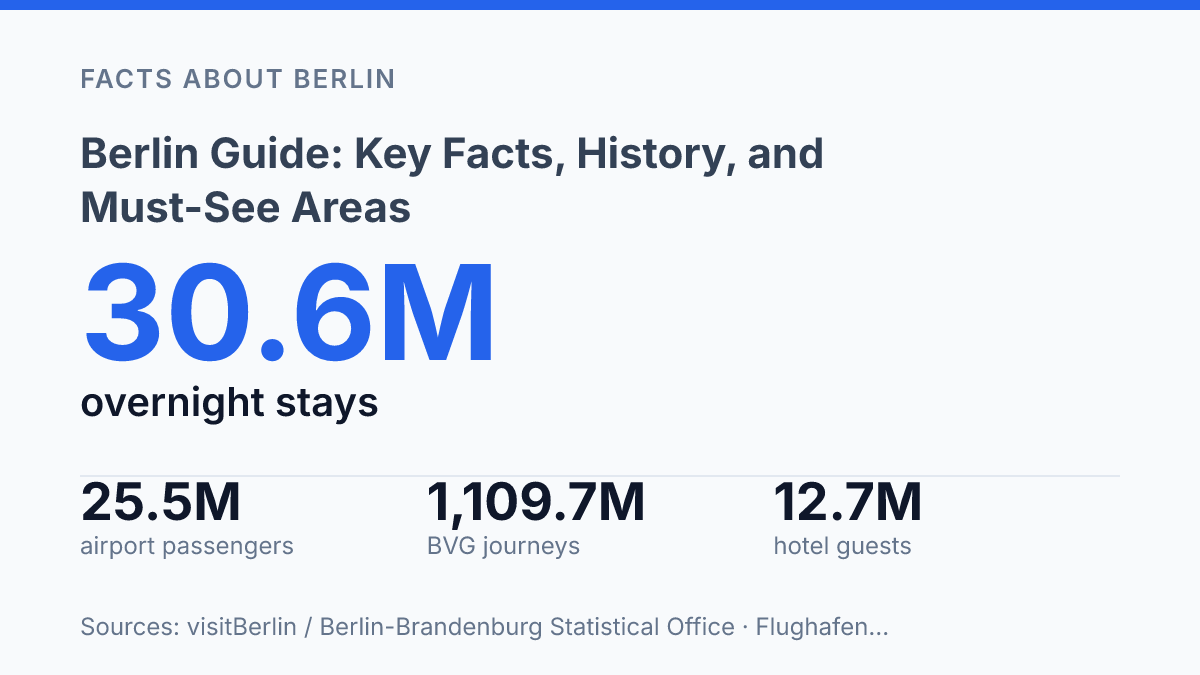
Berlin logged 30.6 million overnight stays in 2024, enough to make “off-season” feel theoretical in the wrong district. The city is busy again, and 42% of those visitors came from abroad. That changes how you should read a guide: not as a checklist, but as a way to make better decisions before the crowds make them for you.
The BVG carried more than 1.1 billion passenger journeys in 2024, but U-Bahn reliability still left about 6 trips in 100 short of perfect. That matters when you’re choosing where to stay, which ticket to buy, and how far from the centre you can safely sleep.
The cost surprise arrives later: from 1 January 2025, the city tax is 7.5%. This guide looks at the districts that reveal the city’s real character, then gets blunt about transport, passes, timing, and costs. In my humble opinion, that’s where good trips are won.
Districts that show the city’s real character
The fastest way to misread Berlin is to treat Mitte, Kreuzberg, and Prenzlauer Berg as stable personalities rather than moving targets. The city’s best-known areas pull you in fast.
They don’t tell the whole story. Polished streets can sit one turn away from older, rougher blocks with a completely different pace.
Mitte gives visitors the clearest sense of formal power and cultural weight. Museum Island anchors that impression with five major museum buildings grouped on the Spree. It feels less like a single attraction and more like a civic statement.
Yet even here, the mood shifts quickly. Government buildings, luxury hotels, quiet courtyards, and everyday apartment blocks all sit closer together than first-time visitors expect.
Kreuzberg works differently. It feels denser, louder, and more lived-in, partly because the combined Friedrichshain-Kreuzberg borough had 14,385 people per km² in 2024, according to Investitionsbank Berlin.
That’s the city’s highest district density. You feel it in the narrow sidewalks, late-night movement, packed parks, and constant overlap between locals and visitors.
Prenzlauer Berg can look calmer at first glance. Its restored facades, broad pavements, and family-heavy streets give it a softer edge than Kreuzberg.
But that polish can be misleading… behind the clean storefronts are old industrial yards, busy transit corridors. A long-running tension between comfort and character. In my view, the mistake is spending all your time in the postcard core and calling the city understood.
The administrative map adds another layer. The city is divided into 12 boroughs. That matters because neighborhood names don’t always match how the city is governed. Mitte can mean both a central locality and a larger borough.
Kreuzberg belongs to Friedrichshain-Kreuzberg. Prenzlauer Berg sits inside Pankow. For visitors, that affects hotel searches, local recommendations, taxi directions, and how far a place really is from the area you think you booked.
Practical details before you go
Hotels recorded 30.6 million overnight stays in 2024, with 12.7 million guests and 42% international visitors, according to visitBerlin / Berlin-Brandenburg Statistical Office. That volume changes how you should plan even a short trip. Book key museum slots, restaurant tables, and central hotels early if you’re coming around holidays, school breaks, or major events.
Most international arrivals come through Berlin Brandenburg Airport, the main air gateway southeast of the city. The airport handled 25.5 million passengers in 2024.
The route into town is routine rather than difficult. Still, the busiest travel days can feel crowded fast, especially when flights land close together.
Rail is the fastest way to cross the city: the U-Bahn and S-Bahn cover most visitor routes better than taxis. A standard AB ticket costs €4.00 and runs for 120 minutes with transfers allowed, but not round trips. Choose ABC if you need the airport zone, or consider a visitor pass if you’ll pair frequent rides with paid attractions.
Don’t mistake easy movement for instant fluency. The city is simple to reach and simple to cross.
It can still feel slow to master. In my honest opinion, the smartest visitors accept that friction instead of fighting it. A missed platform or strange transfer is part of how the place teaches you its rhythm.
Check transport works before you lock in a hotel or timed booking. For major station, street, or public-space projects, a planning horizon of 18 to 24 months is a safer assumption than a quick fix.
That doesn’t mean your trip will be disrupted. It does mean yesterday’s route advice can age badly.
Accommodation pricing has one extra line to watch. From 1 January 2025, the city tax rose to 7.5%. It now applies to paid business stays as well as leisure trips.
The charge won’t ruin a budget. It can surprise you when several nights stack up.
What the city rewards when you plan with numbers
The best next move is boring. It works: choose your base before you choose your sights.
A dense area like Friedrichshain-Kreuzberg can put more of the city at your feet. It can also mean higher rents, louder nights, and less room to improvise.
Then check the calendar. On 27 September 2024, BER handled 99,579 passengers in a single day.
That wasn’t just a number. It was a warning about major events, airport queues, and transit margins.
Treat the city like a working place, not a postcard. In my view, the visitors who enjoy it most aren’t the ones who see everything. They’re the ones who leave enough space for the city to interrupt the plan.
Frequently Asked Questions
Q: What is Berlin best known for?
A: Berlin is known for its Cold War history, its museums. A city layout that still shows old division. The Brandenburg Gate and the Berlin Wall Memorial matter. The city feels more interesting when you notice how present-day neighborhoods sit beside hard history. In my honest opinion, that’s what gives Berlin its edge.
Q: How many days do you need to see Berlin properly?
A: Three full days is the sweet spot for most visitors. That gives you time for major sights, one museum day. A slower look at neighborhoods like Kreuzberg or Prenzlauer Berg. You can rush it in two days, but you’ll miss the city’s rhythm.
Q: Is Berlin expensive for tourists?
A: Berlin can be cheaper than other major European capitals. The price depends on where you stay and how you eat. Street food, bakeries, and public transit keep costs down. Hotels in central areas can push your budget up fast. The tradeoff is simple: comfort costs more, but convenience saves time.
Q: What are the best areas to stay in Berlin?
A: Mitte is the most practical base if you want easy access to major sights and transit. Kreuzberg suits travelers who want more nightlife and local energy, while Charlottenburg feels calmer and more polished. Pick the area that matches your pace, not just the postcard version of the city.
Q: Is Berlin easy to get around without a car?
A: Yes. Berlin’s U-Bahn, S-Bahn, trams, and buses cover the city well, so most visitors don’t need a car at all. The catch is that some places are spread out. A little planning saves you from long transfers.