What do tourists do in Berlin? Mostly the classics: in visitBerlin‘s 2023/24 Quality Monitor, 63% of vacationers chose the city for places of interest, just ahead of art and culture at 61%.
That number cuts through the cliché. Berlin isn’t just a nightlife capital with a few monuments attached. Most visitors come to stand at the Wall, climb into the Reichstag dome, cross Museum Island, eat well, sit in cafés, and wander neighborhoods where the past still interrupts the present.
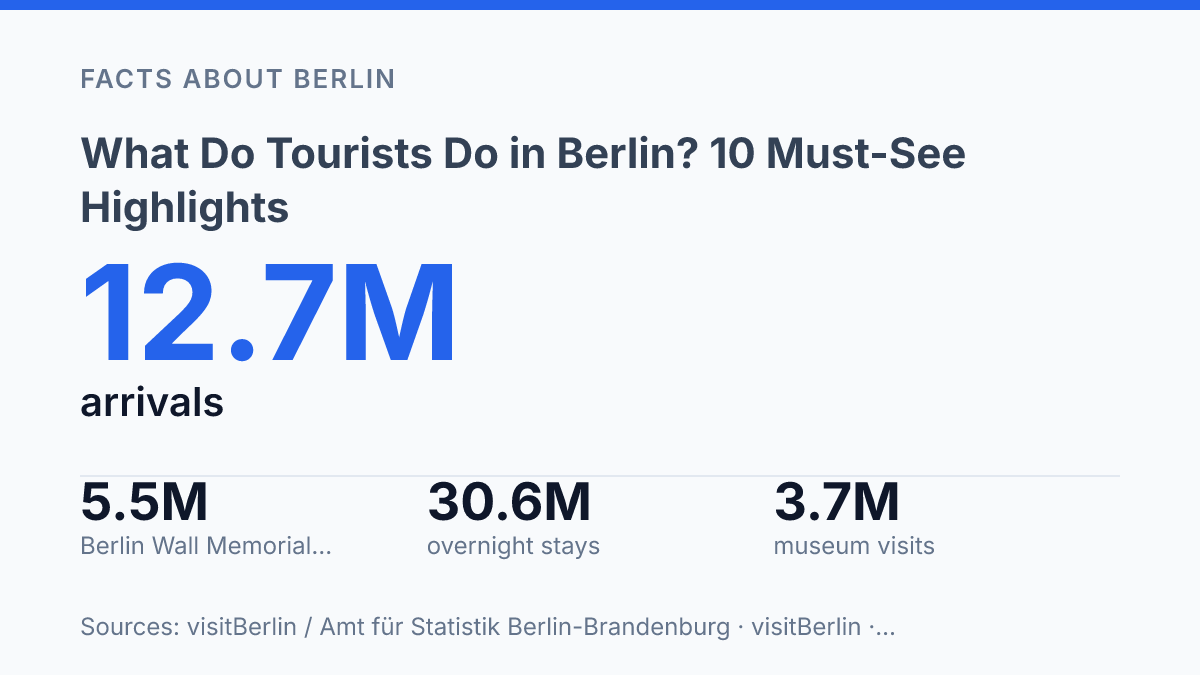
The catch is time. Berlin recorded more than 30.6 million overnight stays in 2024. The average trip lasted only 2.4 days.
That’s enough to see a lot, but not enough to drift without a plan. In my honest opinion, the smartest Berlin visit isn’t packed. It’s edited.
What first-time visitors should not miss
The shortest answer to “What do tourists do in Berlin?” is surprisingly practical: they cluster around three first-stop sights before branching into the city’s harder history.
Start with Brandenburg Gate, then book the Reichstag dome if you want the view to mean something. Museum Island belongs in the same first sweep. It gives you the city’s art-and-antiquity hit without burning half a day on transit.
That priority matches the numbers. In visitBerlin’s Quality Monitor Germany-Tourism 2023/24, places of interest were the top reason vacationers chose Berlin, at 63%, just ahead of art and culture at 61%.
So don’t feel guilty for beginning with the obvious sights. They’re obvious for a reason.
The catch is that Berlin’s most powerful first-time moments are not always the grandest ones. The Berlin Wall Memorial on Bernauer Straße gives you the clearest street-level sense of division.
The East Side Gallery turns that same rupture into a long open-air artwork. visitBerlin’s 2026 ranking put the Wall Memorial at 5.5 million visitors in 2025, including the outdoor area. That tells you plenty about what people actually seek out.
Checkpoint Charlie earns its place mostly through location. It can feel staged.
It sits neatly on a central route and gives first-timers a quick reference point. Pair it with Gendarmenmarkt, where the square feels calm, balanced, and easy to fold into a short walk.
If you’re choosing what not to miss in Berlin, don’t treat every famous stop as equal. In my view, the best first visit mixes the postcard icons with places where the city still feels unsettled. Even with only three days, that route gives you the right shape of Berlin: grand symbols, sharp memory, and enough street-level wandering to keep it real.
The 10 best things to do in the city
Berlin’s smartest top-10 is not ten monuments in a row. It’s one icon, one museum hit, one scar of history, then a snack or neighborhood walk that makes the city feel lived-in. The data backs that mix: in visitBerlin’s Quality Monitor Germany-Tourism 2023/24, vacationers chose the city for places of interest at 63%, art and culture at 61%, and variety or quality of the offer at 53%.
In my honest opinion, the obvious hits are worth doing, but they’re rarely the whole memory.
1. Classic-sightseer move: book the Reichstag dome in advance and go near sunset if you can. The view works best when you can see the government quarter turn from glass and stone into lights.
2. Start or end a walk at Brandenburg Gate, but don’t just take the photo and leave. Cut into Tiergarten afterward for a quieter reset among paths, lawns, and lakes.
3. Culture-first visitors should choose one Museum Island stop, not five rushed ones. The Neues Museum or Alte Nationalgalerie gives you a cleaner win than trying to collect ticket stubs.
4. History seekers should give the East Side Gallery real time.
The murals pull you in fast. The stronger moment is remembering that this is art painted on a border that once meant fear.
5. A Spree boat tour suits anyone who wants orientation without another long walk. You’ll link the government district, museum quarter, bridges, and riverfront in one easy hour.
6. View hunters can use the TV Tower at Alexanderplatz as the big skyline option.
Clear weather matters, though. If the clouds sit low, save the money and stay on the ground.
7. Tempelhofer Feld is the best pick for space, bikes, and Berlin’s odd sense of freedom. Former runways now serve skaters, picnickers, dog walkers, and people doing absolutely nothing.
8. Food stops don’t need to be fancy.
Grab currywurst at Curry 36 or Konnopke’s Imbiss, then move on. The ritual matters more than the sausage.
9. Kreuzberg rewards walkers who don’t need a fixed script. Try the canal paths, Markthalle Neun, Turkish bakeries, and side streets where cafés sit beside street art.
10. For a softer pace, choose Prenzlauer Berg around Kollwitzkiez or Nikolaiviertel near the river.
One gives you leafy cafés and old apartment blocks. The other gives you compact, reconstructed old Berlin.
The best version mixes one headline sight with one low-key stop. Five landmarks can blur together. A museum morning followed by currywurst and a Kreuzberg walk usually sticks.
Can you see Berlin in 3 days?
Berlin is one of the rare capitals where a three-day trip feels rushed on paper but workable on the pavement. Yes, 3 days is enough for a strong first visit.
No, it isn’t enough to feel finished with the city. The tradeoff is depth, not distance.
That short-stay pattern is normal here. According to visitBerlin’s Quality Monitor Berlin 2023/24, 64% of vacationers stayed up to 3 nights. In 2024, the city’s average stay was only 2.4 days overall.
So if you’re planning three days, you’re not doing Berlin “wrong.” You’re doing what a lot of visitors do.
A simple structure works better than a packed checklist. Spend day one on the central sights, using walking and short transit hops to link the big political, architectural, and riverfront areas.
Keep it tight. You’ll enjoy more if you leave space for a long lunch or a café stop instead of racing from one photo spot to the next.
Make the second day your history day. Berlin rewards focus here.
It also punishes overloading. Pick one or two major historical areas and give them proper attention. In my humble opinion, this is where a short Berlin trip either becomes memorable or turns into a blur of plaques, dates, and tired feet.
Use the third day for a slower district or a park. That sounds like a “soft” day, but it’s the part that makes the city feel lived-in rather than toured. Wander, eat, sit outside if the weather cooperates, and stop trying to win the itinerary.
Four to five days changes the trip. You can give museums more time, add a guided tour without sacrificing an afternoon, or take a day trip to Potsdam. You can also revisit an area at night, when the city feels completely different.
Three days gives you the shape of Berlin. A longer stay gives you the texture.
Getting the best trip without wasting time
A Berlin day can collapse faster from one extra museum than from one late train. The smartest plan is not the fullest one. If you try to do everything, the city starts to feel rushed instead of rewarding. In my view, Berlin works best when you leave space for the city to interrupt you.
Use the U-Bahn for short jumps through the center and the S-Bahn when you need to cross longer distances fast. Don’t build your route like a straight line on a tourist map. Build it around stations.
A stop near a sight can save you 20 minutes of backtracking. That matters more than squeezing in one more photo stop.
Museum-heavy days need air. Put a green break between indoor blocks, especially if you’re planning several galleries or memorial sites in one stretch. Tiergarten works well for this near the political center, and Tempelhofer Feld gives you a bigger reset when your day has started to feel too compressed.
Popular timed visits deserve their own slot, not a vague “maybe later.” The Reichstag dome is the clearest example, since advance registration can decide whether you get in at all.
This is where planning beats spontaneity. According to visitBerlin in 2025, 28% of Berlin vacationers booked their trip one to three months ahead, so prime time slots can disappear before late planners even start looking.
Leave one flexible block each day. Not an empty day, just a pocket of room. Berlin rewards the person who can stay longer in a courtyard, take the slower walk, or skip a second queue when the first one ran long.
That’s not wasted time. That’s the part that makes the trip feel like yours.
How to make a short Berlin trip feel intentional
A short Berlin trip works best when you treat time like a ticketed attraction. You can’t see everything, and pretending otherwise turns the city into a checklist.
The better move is to anchor each day around one heavy site, then leave space around it. Start with Berlin Wall Memorial, not because it drew 5.5 million visitors in 2025, but because it changes how you read the rest of the city.
Keep 2.4 days in mind too. That’s the average stay, so your trip is probably normal if it feels tight.
If you’re booking late for 2026, choose fewer fixed reservations and protect your walking time. In my humble opinion, Berlin rewards curiosity more than speed. The city won’t punish you for missing a landmark. It will expose a rushed itinerary.
Frequently Asked Questions
Q: What should you not miss in Berlin?
A: The Brandenburg Gate is the one stop you should not skip. The Berlin Wall Memorial matters too, because it shows the city’s history without sugarcoating it. 1989 still shapes how people read Berlin today, and that’s why these places hit harder than simple sightseeing.
Q: Is 3 days enough for Berlin?
A: Yes, 3 days is enough for a solid first trip. You won’t see everything. You can cover the major sights, a few museums, and one or two neighborhoods without rushing too badly. 3 days works best if you plan your days by area instead of crisscrossing the city.
Q: What are the 10 best things to do in Berlin?
A: The best mix usually includes the Brandenburg Gate, the Reichstag, Museum Island, the Berlin Wall Memorial, the East Side Gallery, Checkpoint Charlie, the TV Tower, a Spree boat ride, Tempelhofer Feld. A neighborhood food stop. That list gives you history, views, and local life in one trip. 10 stops sound like a lot, but Berlin handles that pace better than most cities.
Q: How do tourists usually get around Berlin?
A: Most visitors use the U-Bahn, S-Bahn, trams, and buses because they’re fast and easy to connect. Walking still matters for short stretches, especially in central areas where the sights cluster close together. The surprise is how little you need a car; the U-Bahn does most of the heavy lifting.
Q: What kind of Berlin trip is best for first-time visitors?
A: A first trip works best when you mix major landmarks with one or two quieter stops. That balance keeps the city from feeling like a checklist, and you’ll remember more than just photos. In my view, that’s the smarter way to see Berlin… not by racing from one famous site to the next.