
Is 3 days enough for Berlin? The numbers suggest it is a realistic first-visit length: in 2025, the city averaged about 2.4 nights per guest, while international visitors stayed 2.7 days on average. That places a three-day trip slightly above the typical stay, not below it.
The practical question is less whether Berlin can fill the time and more how much of its historical and cultural weight can be handled without turning the visit into a checklist. visitBerlin’s Quality Monitor shows why the planning matters: sights drive 63% of trips, art and culture 61%, and places of interest are visited by 87% of international vacationers. A well-built route can connect landmarks, memorials, food stops, and one or two major cultural anchors, but Berlin’s museum and memorial scale makes selectivity unavoidable.
What Three Days Can Cover
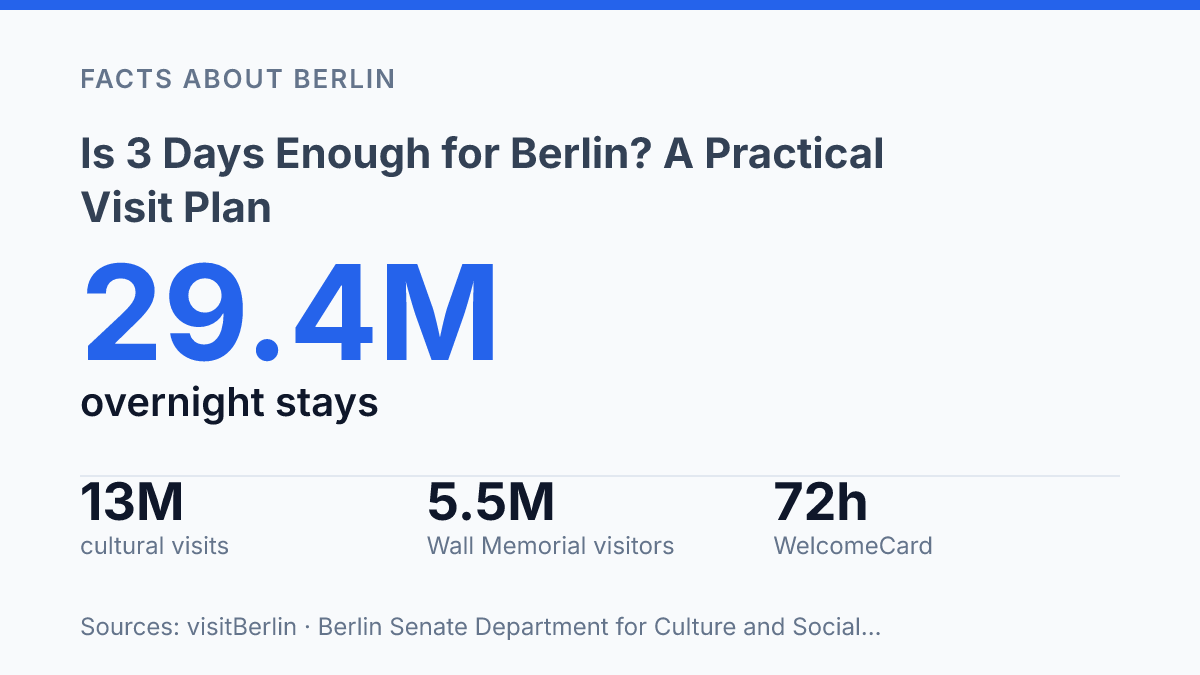
In 2025, Berlin recorded 29.4 million overnight stays by 12.4 million guests, roughly 2.4 nights per guest, according to visitBerlin / Berlin-Brandenburg Statistics Office. That makes a three-day visit slightly more generous than the city’s typical stay pattern, and it is enough for a structured first look at the main landmarks without pretending to exhaust the city.
The easiest coverage comes from Berlin’s central clusters. Museum Island and the Berlin Cathedral sit close enough together to form a natural cultural anchor, especially for visitors who want architecture, riverside views, and one major museum rather than a full museum day. The limitation is scale: this area rewards time, and a three-day plan usually means choosing selectively rather than treating the island as a complete survey of Berlin’s collections.
A second compact cluster covers the city’s political and memorial core. The Brandenburg Gate, the Reichstag area, and the Memorial to the Murdered Jews of Europe can be approached as one circuit because they occupy a relatively concentrated part of central Berlin. This grouping gives a first-time itinerary strong historical context without requiring the trip to become a chronological history lesson.
Other headline stops can be combined more flexibly. Alexanderplatz and the TV Tower work well as orientation points on the eastern side of the center, while Checkpoint Charlie can be fitted into a broader central route when Cold War landmarks are a priority. These are efficient additions because they do not each require half a day unless paired with longer exhibitions or extended nearby stops.
The main tradeoff is depth. Three days can cover the recognizable core of Berlin, including major monuments, one or two cultural anchors, and several central districts. It leaves much less room for slower museum visits, unhurried neighborhood walks in areas such as Kreuzberg or Prenzlauer Berg, and day trips beyond the city, which are the usual reasons a short stay begins to feel compressed.
A Day-by-Day Route That Fits the Clock
In Berlin, the difference between a full three-day plan and a rushed one is often one cross-town transfer too many. A route that assigns each day to a compact area keeps the visit practical while still leaving room for one slower meal, one interior visit, or one extended exhibition. The official 72-hour Berlin WelcomeCard aligns neatly with this structure: as of 2026, BVG and Berlin WelcomeCard list it at €39.50 for zones AB, with unlimited public transport and partner discounts, which makes repeated short transfers less wasteful without encouraging constant zigzagging.
Day 1 should stay in Mitte and the government quarter, using the central location for the highest-density part of the trip. The day works best as a walking-heavy circuit with one timed booking or one longer historical stop, rather than a chain of back-to-back entries. This keeps the first day focused on civic architecture, national history, and the city’s most recognizable core without turning it into a queue-management exercise.
For Day 2, East Side Gallery and Friedrichshain give the itinerary a different texture: open-air Cold War history, riverfront movement, and a stronger evening rhythm. This is also the most logical day for a less formal food stop, since visitBerlin’s Quality Monitor 2025 found that around 57% to 60% of vacationers go to restaurants or cafés during their stay. Keeping the afternoon and evening on the eastern side of the city prevents the day from collapsing into transit between unrelated districts.
Day 3 is best split between Charlottenburg and one chosen cultural stop, rather than treated as a final attempt to collect everything missed. Charlottenburg gives the route a western anchor, while a museum visit can be selected according to interest and opening status. That qualification matters: the Pergamon Museum has been fully closed since October 2023 and is expected to reopen in 2027, according to the Prussian Cultural Heritage Foundation, so antiquities-focused plans need an alternate choice.
A fixed route saves time, but it should not become so rigid that the strongest experiences are shortened. Berlin’s appeal is not only in reaching sites but in having enough space to absorb them, especially at museums, memorials, and restaurants where an extra hour often improves the visit more than another stop would. The efficient three-day plan is therefore not the busiest possible schedule; it is the one with the fewest unnecessary transitions.
When Three Days Feels Too Short
Berlin’s state-funded museums, exhibition venues, and memorials recorded around 13 million visits in 2024, a scale that explains why a short stay can feel compressed for culture-first travelers, according to the Berlin Senate Department for Culture and Social Cohesion. The same source counted 7.3 million visits to memorial sites, which matters because Berlin’s historical appeal is not limited to a single institution or district. A visitor with a general interest can choose one or two anchors; a visitor focused on antiquities, Jewish history, Cold War sites, contemporary art, or memorial culture quickly faces a selection problem rather than a logistics problem.
The most visible museum caveat is the Pergamon Museum, whose long closure has shifted expectations for anyone planning around its antiquities collections. The Prussian Cultural Heritage Foundation reported 1,862,918 visits to Museum Island in 2024, even with the Pergamon out of the normal circuit, showing that the island remains a major draw through its other museums and collections. The expected reopening in 2027 gives the closure a defined planning context, but it does not remove the time pressure: substituting other museums still requires choosing depth over breadth.
Day trips create a different kind of compression because they usually consume most of a day rather than a spare hour. Potsdam appeals to travelers interested in Prussian palaces, gardens, and court history, while Sachsenhausen near Oranienburg is a serious memorial visit that requires time for transport and reflection. Either option can be worthwhile, but inserting one into a three-day stay means sacrificing a substantial block that could otherwise go to museums, neighborhoods, or slower historical visits inside Berlin.
Nightlife and evening culture also make three days feel shorter than the calendar suggests. Berlin’s club culture, late concerts, theatre, opera, cinema programmes, and occasional museum evening openings are not always compatible with early starts the next morning. This is less a warning against a short trip than a matter of fit: the city can be experienced in three days, but the more specific the interest, the more useful an extra night becomes.
Who Should Stay Longer
The strongest case for staying longer is not distance between sights, but the amount of historical and cultural context Berlin rewards when days are not packed edge to edge. visitBerlin’s Quality Monitor 2023/24 found that sights were the leading reason for choosing the city, cited by 63% of respondents, with art and culture close behind. That pattern explains why a short trip can work on paper while still leaving some visitors with a sense that they have only sampled the city’s main layers.
First-time visitors who want both major landmarks and neighborhood variety are the clearest candidates for a fourth day. A broad overview is easier when central sightseeing is separated from less structured time in areas such as Schöneberg, Neukölln, or Wedding, where the value lies less in a single attraction than in streets, food, local shops, parks, and public squares. Extra time also reduces the need to choose between an interior visit, a long lunch, and a neighborhood walk in the same afternoon.
Travelers focused on twentieth-century history often benefit even more from extending the stay. Sites such as Topography of Terror and the Berlin Wall Memorial are not just photo stops; they rely on exhibitions, documentation, preserved ground, and careful reading to make sense of the Nazi period, divided Berlin, surveillance, resistance, and everyday life under political pressure. Visitors with a serious interest in this material may also want time for related institutions such as the Stasi Museum or the German Resistance Memorial Center, which can make a three-day schedule feel interpretively thin rather than merely busy.
An extra day is also practical for anyone planning Potsdam or Sachsenhausen without weakening the city visit itself. Potsdam works best when there is time for palace grounds, historic streets, and transit rather than a rushed out-and-back excursion.
Sachsenhausen requires a different kind of pacing because it is a memorial visit near Oranienburg, and many travelers will not want to place it between dense urban sightseeing blocks. In these cases, four or five days is not a luxury so much as a way to preserve the integrity of both the Berlin stay and the excursion.
The real limit is depth, not distance
A three-day Berlin plan works best when it is treated as a first draft of the city rather than a compressed version of everything. The next practical decision is whether the trip is built around orientation or depth. A 72-hour Berlin WelcomeCard, priced at €39.50 for zones AB, fits the timing cleanly and can reduce friction between districts, but transport efficiency does not solve the harder problem of choosing what to leave out.
That choice will matter even more for museum-led trips while the Pergamon Museum remains fully closed until its expected 2027 reopening. For many first visits, three days is enough to understand Berlin’s shape; it is rarely enough to exhaust its evidence.
Frequently Asked Questions
Q: Is three days enough to see Berlin’s main sights?
A: Three days is enough for a first trip that focuses on Berlin’s core landmarks and a few major museums or neighborhoods. It allows a compact itinerary built around the city’s central districts rather than a full, slower exploration. The main constraint is depth, since many sites need more time if museums, memorials, and local districts are all included.
Q: What should be prioritised on a short Berlin itinerary?
A: The highest-value stops are usually the Brandenburg Gate, the Reichstag area, Museum Island, the East Side Gallery, and one or two historically significant memorials or museums. These sites cover Berlin’s political history, division, reunification, and museum collections in a manageable route. Prioritising them helps reduce transit time and makes a short stay more efficient.
Q: Can Berlin be done as a weekend trip?
A: A weekend visit can cover a meaningful slice of Berlin, but it will feel selective rather than comprehensive. Two full days usually support a strong highlights itinerary, while a third day reduces pressure and leaves room for slower neighbourhood exploring. Shorter stays tend to work best when travel times and museum choices are planned in advance.
Q: How many days are needed for Berlin museums?
A: Museum time depends on whether the goal is one major collection or several institutions on Museum Island and beyond. A single day can cover one or two museums, but a fuller museum-focused trip usually needs more time to avoid rushing. Berlin’s museum options are broad enough that a three-day visit can only sample the strongest highlights.
Q: Is it better to stay central for a 3-day Berlin visit?
A: A central base is usually the most efficient choice for a short trip because it cuts down on cross-city travel. Berlin’s key sights are spread across several districts, so staying near well-connected transit routes helps maximise sightseeing time. That matters most on a three-day itinerary, where even small transit delays reduce the time available for visits.